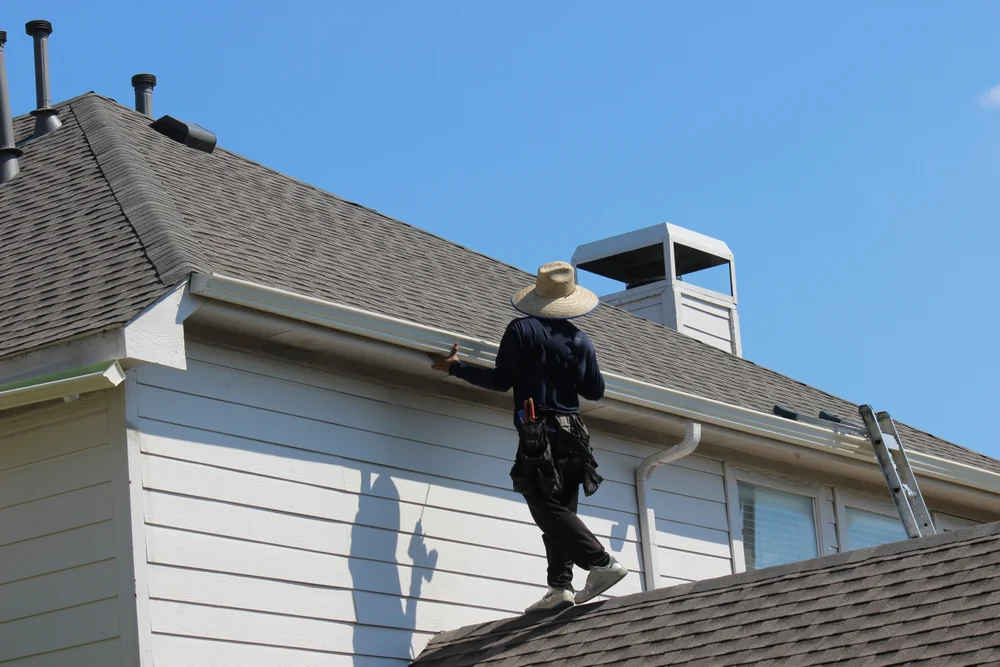
Before you hire anyone for roofing, siding, or windows in Massachusetts, there are legal protections most homeowners never hear about — until something goes wrong.

Most homeowners across Essex County don’t think about contractor licensing until something goes wrong. A deposit disappears. A roof leaks six months after it was “replaced.” A contractor stops returning calls. By then, the options are limited — and expensive.
Massachusetts actually has strong legal protections built specifically for situations like these. But here’s the catch: those protections only kick in when the right boxes are checked before the work starts. This post walks you through what the law requires, what it protects you from, and the one permit mistake that quietly voids everything.
In Massachusetts, any contractor who bids on or performs work on an existing residential property — roofing, siding, windows, doors, decks — is legally required to hold an active Home Improvement Contractor (HIC) registration. This has been the law since 1992 under M.G.L. Chapter 142A, and it applies to every city and town in Essex County, from Lawrence and Haverhill to Gloucester and Newburyport.
The HIC registration isn’t just a formality. It’s administered by the Office of Consumer Affairs and Business Regulation (OCABR) and it ties contractors to a set of enforceable consumer protections — including mandatory written contracts, deposit limits, and access to a state arbitration program. Operating without it carries penalties of up to a $5,000 fine and two years in prison.
This is where a lot of homeowners get tripped up. When you hear “licensed contractor,” you might assume there’s one credential to check. In Massachusetts, there are actually two separate ones — and for most exterior work, you need both.
The HIC registration focuses on business practices and consumer protection. It requires contractors to carry general liability insurance, contribute to the state’s Guaranty Fund, use written contracts, and operate transparently. No exam is required — it’s about accountability, not technical testing.
The Construction Supervisor License (CSL) is different. It requires passing an examination that tests knowledge of the Massachusetts State Building Code. It’s issued by the Office of Public Safety and Inspections (OPSI) and it’s what legally authorizes a contractor to supervise work involving structural elements. For roofing, siding, and window replacement specifically, Massachusetts requires both a valid CSL and active HIC Guaranty Fund participation.
So a contractor can have one without the other — and depending on the work, that means they’re operating outside the law for your project. When you’re vetting anyone for exterior work on your home, you want to confirm both credentials are active, not just one.
The good news is that both are publicly searchable. You can look up HIC registration status at the official MA Contractor Hub (contractorhub.mass.gov), and CSL status through the OPSI database at mass.gov. It takes about two minutes. Any contractor who hesitates when you ask for their registration number is telling you something.
We hold an active HIC registration and the appropriate credentials for the exterior work we perform across Essex County. We don’t ask you to take our word for it — look us up.
Here’s the protection most homeowners in Essex County have never heard of: if you hire a registered HIC and something goes seriously wrong — the contractor abandons the job, fails to complete the work, or an arbitration judgment against them goes unpaid — you may be eligible to recover up to $25,000 from the Massachusetts Guaranty Fund.
That’s a real, state-funded financial backstop. It exists because the legislature recognized that contractor disputes are common enough to require a formal remedy. The Guaranty Fund is funded by contributions from every registered HIC in the state, and it’s administered through OCABR. It’s not an insurance policy you buy — it’s a protection you get automatically when you hire a properly registered contractor.
But it comes with conditions, and one of them catches homeowners off guard more than any other.
The Guaranty Fund only applies when the registered contractor pulls the permits for the work. If a homeowner pulls their own building permit — even with good intentions, even because the contractor suggested it — they are excluded from Guaranty Fund protection under M.G.L. c. 142A. This is codified in state law and confirmed by municipal building departments across Essex County.
Some contractors ask homeowners to pull permits as a way to avoid accountability. It shifts all liability to the homeowner and removes the contractor from the inspection process. If a contractor ever suggests you pull your own permit for roofing, siding, or window work, treat it as a serious red flag.
The law is clear: the registered HIC is responsible for pulling all permits for covered work. That’s not a technicality — it’s the mechanism that keeps the entire protection system intact. We pull every permit ourselves. That’s not something we do as a favor; it’s what the law requires and what protects you if anything ever goes sideways.
Want live answers?
Connect with a Paradise Remodeling Inc. expert for fast, friendly support.
Knowing that credentials exist is one thing. Actually checking them takes about two minutes and can save you from a serious problem down the road. Massachusetts makes both databases publicly accessible, and you don’t need to create an account or pay anything to use them.
For HIC registration, go to contractorhub.mass.gov and search by business name or registration number. The result will show you whether the registration is active, when it expires, and whether any complaints or disciplinary actions are on record.
For CSL verification, use the license lookup tool at mass.gov through the OPSI portal — search by name or license number and confirm the license type matches the work being done.
The credential search is the starting point, not the finish line. Once you’ve confirmed the HIC registration and CSL are active, there are a few other things worth checking before you sign anything.
Ask to see proof of general liability insurance and workers’ compensation coverage. Under Chapter 142A, these are required as conditions of HIC registration — but insurance lapses happen, and a certificate of insurance from last year doesn’t tell you the policy is still active. Request a current certificate with your name listed as the certificate holder.
Look at the written contract before any money changes hands. Massachusetts law requires a written contract for any home improvement project over $1,000. That contract must include the contractor’s HIC registration number on the first page, a clear scope of work, a payment schedule, and the project timeline. If a contractor hands you a vague one-page agreement with no registration number and asks for a large cash deposit upfront, that’s a problem. Under state law, deposits are capped at one-third of the total contract price.
Check reviews across multiple platforms — not just one. A contractor with consistent, specific feedback on HomeAdvisor, Google, and Yelp over time is a different picture than one with a handful of reviews on a single site. Look for patterns: do reviewers mention punctuality, communication, and the quality of the finished work? Or are there repeated mentions of delays and unanswered calls?
For Essex County homeowners, this vetting process matters especially in the weeks after a major nor’easter or storm. The Massachusetts Attorney General has specifically warned that contractor scams spike after storm events — door-to-door operators who claim they “noticed damage” on your roof are a documented pattern on the North Shore. A legitimate contractor doesn’t need to cold-call your neighborhood after a storm to find work.
Short answer: almost certainly yes — and the permit is your contractor’s responsibility to pull, not yours.
In Massachusetts, building permits are required for roofing replacement, siding replacement, and window replacement on residential properties. This applies throughout Essex County, whether you’re in Salem, Beverly, Methuen, Andover, or Ipswich. The specific requirements can vary slightly by municipality, but the state-level rule is consistent: covered home improvement work requires a permit, and a registered HIC must be the one to obtain it.
Why does this matter beyond the legal technicality? Because a permit triggers an inspection. When a licensed building inspector reviews the completed work, you have an independent set of eyes confirming that the installation meets the current Massachusetts State Building Code — the 10th edition of which went into effect in October 2024. That inspection record also matters when you sell your home. Unpermitted work can surface during a buyer’s home inspection, create title insurance complications, and require disclosure. In some cases, buyers demand that retroactive permits be pulled before closing, which can be expensive and time-consuming.
There’s also the insurance angle. If your roof is replaced without a permit and you later have a water intrusion claim, your homeowner’s insurance carrier may have grounds to deny or reduce the claim if the work was done outside code compliance.
Essex County’s housing stock skews older — much of the North Shore is full of Victorian-era, Colonial, and early 20th-century homes that were built long before current energy and structural codes existed. When that older framing and sheathing gets touched during a re-roof or re-side, the permit process ensures the work is done to modern standards. That’s not bureaucratic overhead — it’s protection for the investment you’ve already made in your home.
We pull every permit required for every job we take on. It’s part of what you’re hiring us for.
The rules Massachusetts put in place for home improvement contractors aren’t complicated — but they only protect you if you know they exist. Verify the HIC registration and CSL before you sign anything. Confirm that your contractor will pull all permits. Make sure the written contract includes the registration number, a clear scope, and a payment schedule that doesn’t ask for more than one-third upfront. And if anything about the process feels evasive or rushed, trust that instinct.
Essex County homeowners have real legal recourse when things go wrong — up to $25,000 through the Guaranty Fund — but only when the work was done through a properly registered contractor who followed the process. That protection disappears the moment a homeowner pulls their own permit or hires someone operating outside the law.
If you have questions about a project or want to know exactly where we stand on any of this, reach out to us directly. We’ll give you straight answers and a free quote — no runaround.
Summary:
Article details:
Share: