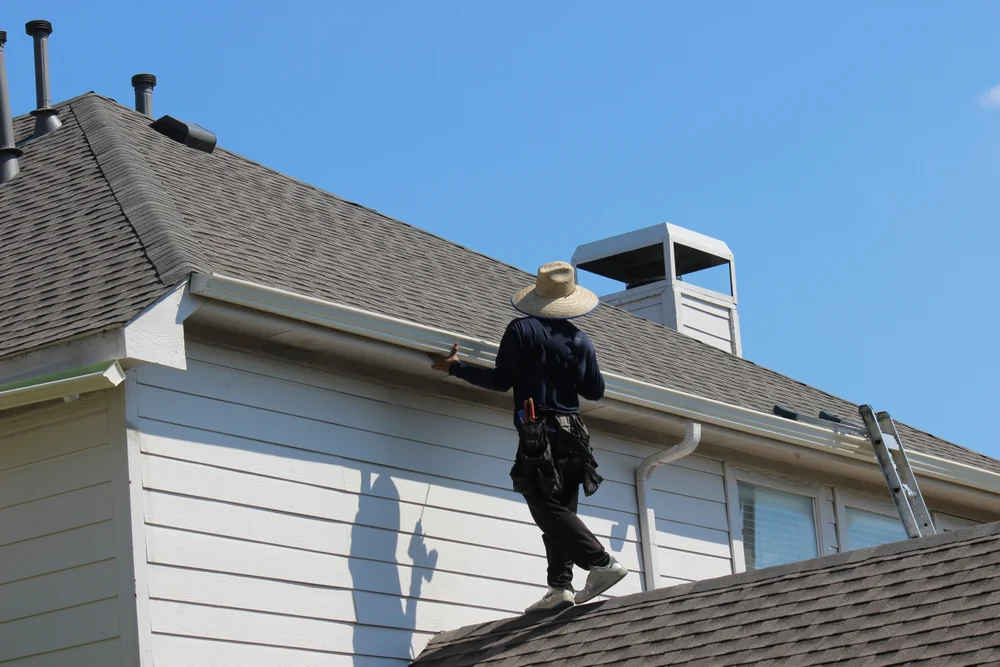
Ice dams don't start in January. They start the moment fall ends and your attic, roof, and gutters are left unchecked. Here is what to do now.

If you’ve ever walked into your living room after a January storm and found a water stain spreading across the ceiling, you already know what ice dams can do. What most people don’t realize is that the damage didn’t start that morning. It started weeks earlier, when heat quietly escaped through the attic, melted snow on the upper roof, and allowed that water to refreeze right at the eave line until there was nowhere left for it to go except under your shingles. The good news is that ice dams are largely preventable, and the time to act is before the first snowfall, not after. Here is what you need to know.
Ice dams aren’t really a roofing problem. They are a heat-loss problem that shows up on your roof. When warm air leaks from your living space into the attic, it heats the underside of the roof deck. Snow on the upper roof melts, and that water flows downward until it hits the cold eave overhang, where it refreezes. Each freeze-thaw cycle builds the ice ridge a little higher, until water starts backing up under the shingles.
What makes this region especially vulnerable is the climate pattern itself. Southern NH and northern MA don’t stay cold and frozen all winter. Instead, temperatures oscillate above and below freezing repeatedly, sometimes within the same week. That cycling is what turns an ice dam from a minor nuisance into a structural problem.
The housing stock along the Merrimack Valley corridor, running from Methuen and Lawrence through Haverhill and Lowell, and across the river into Salem and Derry, was not built for modern energy standards. A significant share of homes in this region date to pre-1960 construction. These properties were built before attic insulation was taken seriously, and many of them have never been updated to reflect current knowledge about heat retention and airflow.
The current recommendation for attic insulation in this climate zone is a minimum of R-49, with R-60 considered preferable. Most older homes in Essex and Rockingham Counties fall well short of that mark. But here is the part that surprises people: adding more insulation over an unsealed attic doesn’t solve the problem. Warm air bypasses insulation entirely if there are gaps around plumbing stacks, recessed light fixtures, chimney chases, or attic hatches. The correct sequence is always air sealing first, insulation second.
Beyond insulation, ventilation matters just as much. A properly ventilated attic keeps the roof deck cold and uniform, which is your goal. The standard is roughly one square foot of net free ventilation area per 300 square feet of attic floor, split evenly between soffit intake and ridge exhaust. When that balance is off, warm pockets form on the roof deck that melt snow unevenly, which is where ice dams tend to start.
For homeowners in post-war colonials in Derry or Bedford, triple-deckers in Lowell and Lawrence, or older cape cods throughout Essex County, this is worth taking seriously. The homes that get ice dams year after year almost always share the same underlying issues: inadequate insulation, unsealed air bypasses, and ventilation that hasn’t been evaluated in decades.
Most ice dam discussions focus on the attic and roof, as that is where the root cause lives. However, other parts of your home can make the problem worse, and they are often overlooked entirely.
Gutters are the most direct example. When gutters are clogged with leaves and debris heading into winter, they freeze solid during the first cold snap. A frozen gutter cannot drain. So when meltwater flows down from the upper roof, it has nowhere to go and backs up directly under the shingles. Pre-winter gutter cleaning isn’t glamorous, but it is one of the most straightforward ways to reduce your risk. Homes along the heavily wooded stretches of Route 125 through Haverhill and Plaistow, or the tree-lined neighborhoods of Andover and North Andover, tend to accumulate significant debris in the fall.
Windows are a less obvious factor, but a real one. Drafty or poorly insulated windows allow cold air to infiltrate the living space, which drives up heating demand and increases the amount of warm air being pushed toward the ceiling and into the attic. If you’ve noticed your heating bills climbing every winter, or felt cold drafts near window frames in older rooms, that isn’t just a comfort issue; it contributes directly to the heat-loss cycle that feeds ice dams.
Siding works the same way. Gaps, aging caulk, and poorly insulated exterior walls allow cold air to penetrate the building envelope, increasing the thermal load on your heating system and making it harder to maintain stable indoor temperatures. Insulated vinyl siding, properly installed, creates a tighter envelope that reduces that infiltration. As a side benefit, it lowers the chances of ice dams forming.
The point isn’t that you need to replace everything at once. It is simply that ice dams are a whole-house issue, and a contractor who only looks at the roof is seeing part of the picture.
Want live answers?
Connect with a Paradise Remodeling Inc. expert for fast, friendly support.
The main thing to understand about ice dam prevention is that your window to address it is narrow. Once snow covers the roof, your options shrink to emergency removal and damage control. The time to find and fix vulnerabilities is before the first snowfall, ideally after the leaves have fallen so the roof and gutters are fully visible, and before temperatures drop far enough to make attic work difficult.
That window runs roughly from October through mid-November across Essex County, Rockingham County, and the Hillsborough County corridor. Southern NH averages around 60 inches of snowfall per year, and in heavier winters, that number climbs significantly. The first major nor’easter can arrive as early as November, so waiting until December is cutting it close.
A thorough pre-winter inspection isn’t a five-minute walk around the perimeter. It is a systematic look at every system that contributes to ice dam risk, which means going beyond the roof surface.
On the roof itself, the inspection should check flashing conditions around chimneys, skylights, and pipe penetrations, since these are common points where water infiltrates during ice dam events. The drip edge and eave condition matter too, because a compromised drip edge lets water wick back under the roofing material instead of shedding cleanly. Valleys, where two roof planes meet, are another high-risk area. If an ice and water barrier was installed during your last roof replacement, it should extend at least 24 inches inside the interior wall line, which is the standard for Massachusetts and New Hampshire climate conditions.
In the attic, the inspection should evaluate insulation depth and type, identify any visible air bypasses around penetrations, and assess whether the soffit-to-ridge ventilation path is clear and balanced. A thorough contractor will also look for signs of previous ice dam intrusion, such as staining on the rafters, damaged insulation near the eaves, or frost patterns on the sheathing that indicate where heat is escaping.
Gutters should be cleared and checked for proper slope and secure attachment. Gutters that have pulled away from the fascia even slightly will collect standing water that freezes and compounds the problem. Downspout extensions should direct water safely away from the foundation, a detail that matters during the spring thaw just as much as in winter.
The goal of a pre-winter inspection isn’t to sell you an endless list of repairs. It is to give you a clear picture of where your home stands heading into a New New England winter, allowing you to prioritize corrective work before the first snowfall closes that window.
One of the most common questions we hear is whether homeowners insurance covers ice dam damage. The short answer is that most policies cover sudden water damage to ceilings, walls, and insulation caused by an ice dam event. What they typically do not cover is the cost of removing the ice dam itself, the prevention work needed to stop it from happening again, or any damage that an adjuster attributes to deferred maintenance. If a claim is denied on the grounds that you knew about the problem and failed to address it, the repair bill falls entirely on you. Proactive prevention is the only way to fully protect yourself financially.
Another question we hear often is if ice dams can form on a relatively new roof. The answer is yes. A new roof with proper ice and water barrier installation is more resistant to water infiltration during an ice dam event, but it doesn’t stop ice dams from forming in the first place. The dam forms because of heat escaping through the attic, and a new roof doesn’t change what is happening on the underside of the roof deck. This misunderstanding leads some homeowners to assume they are protected when they aren’t.
Homeowners in Nashua, Manchester, and across Hillsborough County frequently ask if the snowfall totals in this region are severe enough to justify this kind of preparation. Southern NH averages around 60 inches of snow per year, and in heavier winters, Concord has recorded over 90 inches. The January 2026 storm alone deposited nearly two feet of snow across the NH Seacoast region in a single event. That is more than enough to create ice dam conditions on any home experiencing attic heat loss, which applies to most homes in this region.
Finally, people ask if ice dams can form with light snowfall. They can. Ice dams have been documented forming with as little as two inches of snow accumulation on the roof. It doesn’t take a blizzard; it just takes the right combination of attic heat, snow cover, and freezing temperatures at the eave. All three are present here from November through March.
Ice dam prevention comes down to one principle: keep the roof cold and uniform. That means sealing air bypasses in the attic, bringing insulation up to the R-49 minimum this climate zone requires, maintaining balanced soffit-to-ridge ventilation, and making sure gutters, flashing, and the roof surface are in good shape before the first snowfall.
The homes most at risk in Essex County, Middlesex County, and across Rockingham and Hillsborough Counties are the ones that haven’t been evaluated in years. Older housing stock, aging gutters, and attics that were never properly air-sealed are common here. That is simply the reality of a region built largely before modern energy standards existed.
The difference between a winter with ice dams and one without usually comes down to the steps you take in October and November. Don’t wait for water to drip through your ceiling this January. Schedule a pre-winter roof and attic inspection with Paradise Remodeling Inc today.
Summary:
Article details:
Share: