Not every roof claim gets approved — and the reason usually comes down to policy type, documentation, and timing. Here's what Essex County homeowners need to know.
A storm rolls through the North Shore. You find shingles in the yard, a water stain on the ceiling, or a gutter hanging off the fascia. Your first instinct is probably to call a roofer — but before you do anything, it helps to understand what your insurance policy will actually pay for, and what it won’t.
Massachusetts homeowner policies aren’t all the same, and the difference between getting a check that covers your repair and getting one that barely covers half of it often comes down to a few details most people don’t know to look for. Here’s what you should understand before you pick up the phone.
When roof damage happens, your homeowner’s insurance policy may cover the cost of repair or replacement — but only if the cause of the damage is a “covered peril.” In Massachusetts, most homeowners carry either an HO-2 (Broad Form) or HO-3 (Special Form) policy. HO-2 policies cover a specific list of named events: windstorm, hail, falling objects, and weight of ice or snow, among others. HO-3 policies cover everything except what’s specifically excluded — which generally means they offer broader protection.
What’s almost always excluded, regardless of policy type, is damage caused by age, neglect, or gradual wear and tear. That distinction — sudden storm event versus slow deterioration — is where most claim disputes happen. In Essex County, where coastal homes in Salem, Beverly, and Gloucester face salt air and hard winters year after year, that line can be genuinely difficult to establish without the right documentation.

This is the detail that catches most homeowners off guard, and it matters more than almost anything else in the claims process.
If your policy pays on an Actual Cash Value (ACV) basis, your insurer will calculate what your roof was worth at the time of the storm — not what it costs to replace it today. A roof that cost $30,000 to install but is now ten years old might be depreciated down to $12,500 after your deductible. You’re responsible for the rest out of pocket. On a Replacement Cost Value (RCV) policy, that same roof could yield a payout closer to $27,000.
Here’s the part that trips people up on RCV policies: the insurer doesn’t send you the full amount upfront. The first check covers the depreciated value — the ACV portion. The second check, which releases the withheld “recoverable depreciation,” only comes after the work is completed and properly documented. That’s not a delay tactic. It’s standard practice. But if you don’t know it’s coming, that first check can feel like the end of the road when it’s actually just the beginning.
There’s a third structure worth knowing about: a Roof Payment Schedule (RPS). Under this type of policy, coverage is prorated by age. A 15-year-old roof might only be covered at 30% of replacement cost — meaning you’d owe 70% out of pocket even if a storm is entirely responsible for the damage. These policies are becoming more common, and homeowners in older Essex County communities like Newburyport, Ipswich, and Marblehead — where housing stock often predates modern roofing standards — are especially likely to encounter them.
The bottom line: before you file a claim, pull out your policy and confirm which structure applies to you. The difference in what you receive can be substantial.
Wind damage is the most common covered peril in Essex County — and one of the most frequently underpaid. The issue isn’t that insurers refuse to cover wind damage. It’s that the scope of what gets documented during the adjuster’s visit often doesn’t capture everything that’s actually damaged.
When an adjuster comes out, they’re looking for obvious, visible damage: missing shingles, lifted flashing, exposed decking. What they often miss — or undervalue — are subtler indicators like wind creasing along shingle edges, compromised sealant strips, and damage to step flashing at roof-wall intersections. These are legitimate damage items, and they’re also code-required upgrade line items under Massachusetts building code (780 CMR) that can be included in a properly documented claim.
There are also items that adjusters routinely leave off the scope of loss that a knowledgeable contractor will flag: ice and water shield coverage to current code, drip edge replacement, and proper underlayment. These aren’t extras — they’re required by 780 CMR whenever roofing work is permitted in Massachusetts. If the adjuster’s estimate doesn’t include them, the scope is incomplete, and you’re left holding the difference.
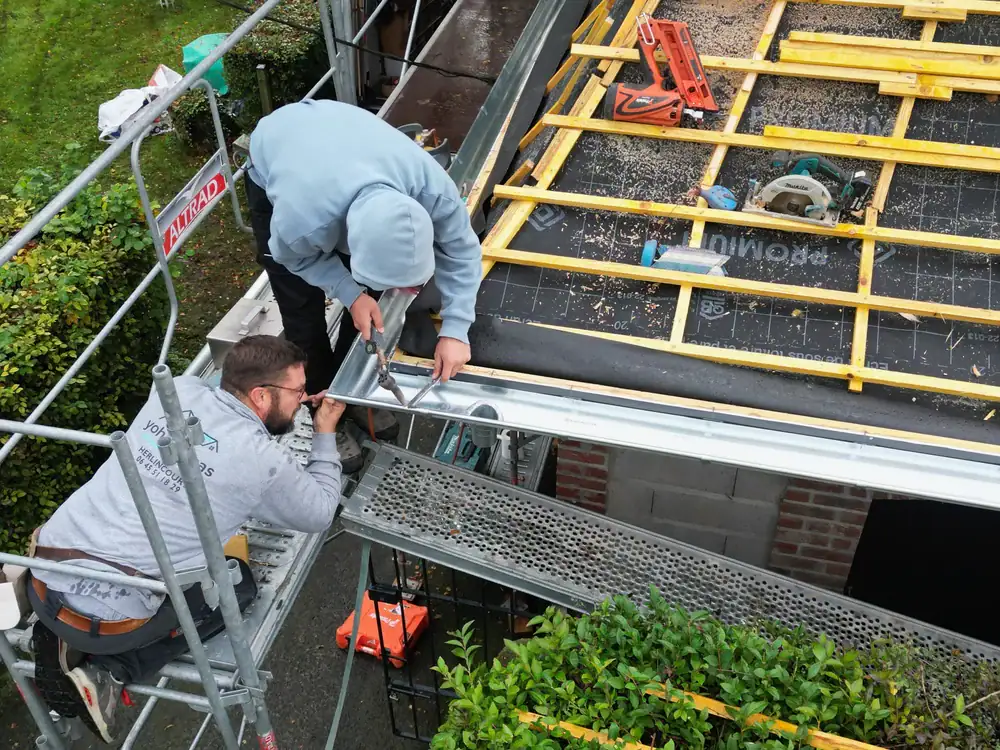
This is why having a contractor present during the adjuster inspection changes the outcome. Not to negotiate — under Massachusetts General Laws Chapter 175, only a licensed public adjuster can negotiate claim terms on your behalf — but to walk the roof alongside the adjuster and make sure nothing gets missed. The contractor documents the damage, identifies code-required items, and provides a detailed written estimate that reflects the actual scope of work. That estimate becomes your evidence if you need to challenge a low settlement or file a supplemental claim later.
Essex County sees its share of severe wind events. The coastal communities from Gloucester down to Swampscott face direct Atlantic exposure during nor’easters, and inland towns like Haverhill, Andover, and Lawrence aren’t sheltered from the gusts that come through the Merrimack River valley. If your roof took wind damage, the question isn’t just whether it’s covered — it’s whether the full scope of that damage gets properly captured.
Want live answers?
Connect with a Paradise Remodeling Inc. expert for fast, friendly support.
Hail and ice dams are two of the most misunderstood scenarios in the Massachusetts homeowner insurance world. Both are potentially covered — but both come with conditions that can reduce or eliminate a payout if the claim isn’t handled correctly.
Hail damage is particularly tricky because it’s often invisible from the ground. A hailstorm that passes through Peabody or Danvers in July might bruise shingles in a way that doesn’t produce a leak for months. By the time water appears on the ceiling, the homeowner may not connect it to a storm that happened two seasons ago. Most Massachusetts policies require claims to be filed within one to two years of the event — and insurers have access to third-party storm tracking data that tells them exactly when and where hail fell. Waiting too long, even with legitimate damage, can result in denial on timeliness grounds alone.

Hail claim payouts vary widely depending on your policy type, the age of your roof, your deductible, and the extent of the damage. On average, hail damage claims settle somewhere between $9,000 and $15,000 — but that range is almost meaningless without knowing what kind of policy you’re carrying.
On an ACV policy, a 15-year-old roof that costs $20,000 to replace might yield a payout of around $5,000 after depreciation and your deductible. On an RCV policy with the same damage, you could receive the full replacement cost in two payments — the first covering the depreciated value, the second releasing the held depreciation once the work is completed and inspected.
The inspection step matters more than most people realize. In Massachusetts, any roof replacement or significant repair requires a building permit. After the work is done, a local building inspector must sign off before the insurer will release the depreciation holdback on an RCV policy. A contractor who pulls permits protects your ability to collect that second check. One who doesn’t — whether to cut costs or move faster — effectively costs you money you’re entitled to.
Hail damage is also documented using a specific methodology: adjusters look at test squares, typically 10-by-10-foot sections of each slope, to count the number of impacts and determine whether the density warrants full replacement or just repair. A contractor who understands this process and can document test squares accurately gives you a much stronger claim than one who simply takes photos and submits an estimate.
Ice dams are a fact of life on the North Shore. When heat escapes through the roof deck, it melts the snow above it. That water runs down and refreezes at the eaves, building up a dam that forces water back up under the shingles and into the home. For older homes in Gloucester, Rockport, Newburyport, and Beverly — many of which were built before modern attic insulation standards — this is a recurring winter problem.
The coverage question is genuinely complicated. Sudden water intrusion caused by an ice dam may be covered under your homeowner’s policy as an accidental discharge of water. But insurers will look carefully at whether the ice dam formed because of inadequate attic insulation or ventilation — and if they determine that poor maintenance contributed to the problem, they may reduce or deny the claim.
That means documentation and timing matter enormously. If you wait until the ice melts to assess the damage, the evidence of what caused it may be gone. Acting quickly — getting a contractor out while the ice is still present, photographing the dam, the water intrusion point, and the interior damage — gives you a much stronger position when the adjuster arrives.
It’s also worth noting that ice dam damage can affect more than just the roof. Water that backs up under shingles can damage the underlayment, the decking, the fascia, the soffit, and the interior ceiling and walls. A full assessment — not just a roofing inspection — gives you an accurate picture of the total claim scope. In Essex County, where nor’easters can produce a week of freeze-thaw cycles in a single storm, that full picture matters.
The homeowners who get the most out of their roof insurance claims are the ones who move quickly, document thoroughly, and work with a contractor who understands the process — not just the roofing.
That means someone who can be present at the adjuster inspection, identify code-required line items that belong in the scope of loss, pull the necessary permits, and see the job through to the final inspection that releases your full payout. It also means someone who won’t push you toward a full replacement when a repair is the right answer — because an inflated estimate can create disputes that slow everything down.
Essex County has declared 27 weather disasters since 1972. Nor’easters, hail, coastal wind, and ice dams are not hypothetical risks here — they’re seasonal realities. If your roof has taken damage and you’re trying to figure out where to start, we at Paradise Remodeling Inc offer free on-site assessments and have been working on roofs across the North Shore and Merrimack Valley for over a decade. Reach out and we’ll take a look at what you’re dealing with.
Summary:
Article details:
Share: