Repair or replace? It's the question every Essex County homeowner faces when their siding starts showing its age — and getting it wrong is expensive either way.

Most homeowners don’t start thinking about siding until something goes wrong — a panel cracks after a nor’easter, a section starts pulling away from the house, or an interior wall shows a water stain that shouldn’t be there. Then comes the question nobody wants to answer without more information: do I fix what’s there, or replace the whole thing?
Get it wrong in either direction and it’s expensive. Repair when you should replace, and you’ll be paying again in a year or two. Replace when repair would have done the job, and you’ve spent $15,000 or more you didn’t need to spend. Here’s how to think through it clearly.
Vinyl siding is built to last between 20 and 40 years, depending on climate, installation quality, and how well it’s been maintained over time. In a moderate climate with minimal weather stress, you might get the full 40. In Essex County, you’re probably not getting that.
The freeze-thaw cycles here are a real mechanical stressor. Water works its way into micro-cracks in the panels, freezes, expands, and widens those cracks — sometimes dramatically — over the course of a single winter. Coastal towns like Gloucester, Rockport, Beverly, and Marblehead add salt air to that equation, which accelerates corrosion on metal components and speeds up the breakdown of older materials. What lasts 35 years in a milder market may need attention at 20 here.
Age is the starting point of any honest repair vs. replacement conversation. If your siding is under 15 years old and the damage is isolated, repair is almost always the right call. If it’s pushing 30 or beyond — especially if it was original to the house when you bought it — the math shifts dramatically.
Cost is usually the first thing homeowners want to know, and it’s a reasonable place to start — as long as you’re comparing the right numbers. Repairing a few damaged vinyl panels typically runs between $100 and $400 per panel in Essex County. Fiber cement or wood panels cost more to repair, generally between $300 and $800 per panel, depending on the extent of the damage. For a minor repair job covering a small section, you’re often looking at $250 to $600.
Full replacement is a different conversation entirely. Vinyl siding installed in Massachusetts runs roughly $4 to $9 per square foot. Fiber cement — what many North Shore homeowners choose for its durability and resale performance — comes in at $18 to $22 per square foot installed. Wood siding runs $26 to $32 per square foot. For a typical home, full replacement can range from $6,000 to well over $20,000 depending on material, home size, and the condition of what’s underneath.
Here’s the rule that actually helps: when the cost of repair starts approaching 30 to 50 percent of what full replacement would cost, replacement usually wins on long-term value. Not because replacement is always better, but because repeated repairs on a system that’s near the end of its life add up fast — and they don’t stop the clock on the underlying deterioration.
Fiber cement siding pays back 76 to 86 percent of its cost at resale. In Essex County, where the median home value sits at $619,100, that’s not a trivial number. If you’re planning to sell within a few years, the replacement calculus looks different than if you’re staying put for another decade.
Here’s something that catches a lot of homeowners off guard: even when repair is structurally the right call, it can create an aesthetic problem that’s hard to undo. Vinyl siding fades over time. It’s gradual enough that you don’t notice it day to day, but after 10 or 15 years, the panels on your house have shifted meaningfully from their original color. New replacement panels — even from the same manufacturer, same product line, same color code — won’t match weathered existing panels. The difference is often visible from the street.
This doesn’t automatically mean you should replace everything. But it does mean you need to factor it in before committing to a repair. If the damaged section is on a less visible side of the house, the mismatch may not matter much. If it’s on your front elevation, you might be trading a cracked panel for a patchwork appearance that follows you every time you pull into the driveway.
A good contractor will be upfront about this. They’ll tell you what the match is likely to look like before the work starts, not after. If you’re getting bids and nobody mentions the color-matching question, that’s worth noting. It’s one of those details that separates contractors who have done this work for a long time from ones who are just trying to close the job.
We’ve been doing this work in Essex County since 2006 — over 500 homes installed across the county. Color matching is a conversation we have early, because it affects the decision in ways homeowners don’t always anticipate.
Want live answers?
Connect with a Paradise Remodeling Inc. expert for fast, friendly support.
Not all damage is equal. A cracked panel from a stray branch is a very different situation from widespread warping on three sides of the house. The visible damage is just the starting point — what matters more is what’s happening behind it.
Moisture infiltration is the factor that turns a repair into a replacement. When water gets behind siding panels and sits against the sheathing or framing, it creates conditions for rot and mold that spread well beyond the area you can see from the outside. A repair that addresses the surface without addressing what’s behind it isn’t really a repair — it’s a delay.
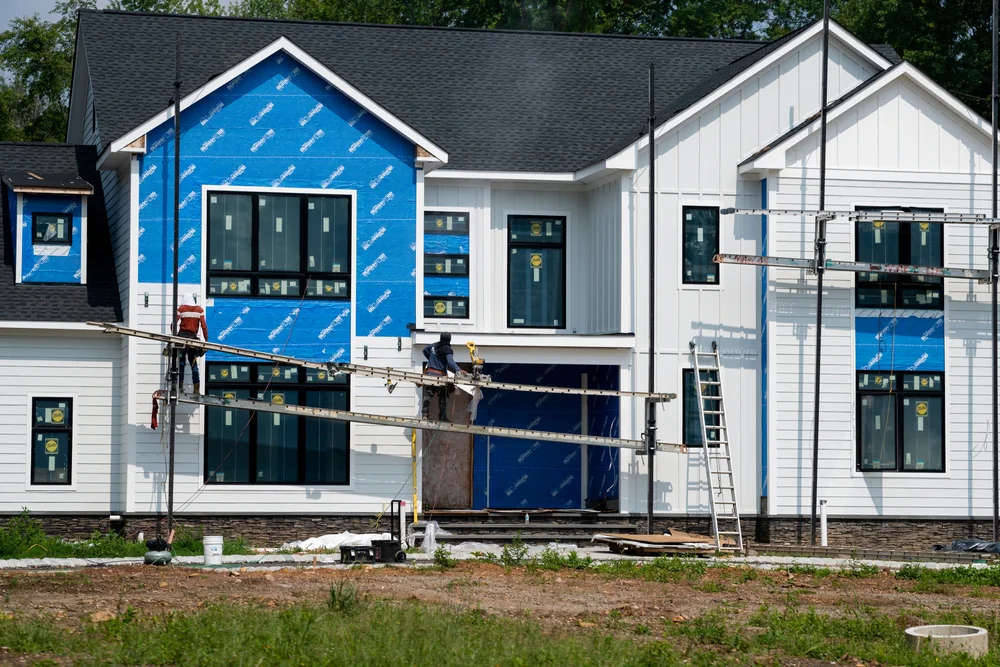
There are specific indicators that push a situation past the repair threshold, and most of them aren’t things you can spot from the curb. Warping or buckling across multiple sections suggests the panels have been absorbing moisture over time — not just in one spot, but systemically. Persistent drafts near exterior walls, even after weatherstripping has been checked, often point to gaps or failures in the siding system itself. Interior water stains that trace back to an exterior wall are a serious sign that moisture has already made it through.
Mold or mildew on the interior side of an exterior wall is another one. By the time mold is visible inside, the conditions behind the siding have usually been wet for long enough that the damage extends significantly beyond what a surface repair can address.
For Essex County’s older housing stock — particularly in Lynn, Lawrence, Haverhill, Salem, and Gloucester — many homes have original aluminum siding or early-generation vinyl that’s thinner than what’s manufactured today. If that material is showing widespread failure, repair is often just postponing the inevitable. A professional assessment will tell you whether what you’re looking at is a localized problem or a system that’s finished.
In Massachusetts, contractors working on owner-occupied residential properties are required to hold a Home Improvement Contractor registration. Paradise Remodeling Inc holds HIC #204634, which you can verify at mass.gov. It’s a basic step that filters out a lot of risk when you’re getting bids.
The repair vs. replacement decision comes down to five things: how much of the surface is damaged, what condition the substrate behind it is in, how old the material is and how much life it has left, whether you’re planning to sell, and what the local labor market looks like for the work. Essex County checks specific boxes on several of those.
If the damage is genuinely isolated — one section, one side, no evidence of moisture behind the panels, siding that’s under 20 years old — repair is almost always the right answer. Get the panels replaced, make sure the flashing and weather barrier are intact behind them, and you’re done.
If the damage is widespread, if the siding is aging out regardless of the current damage, if there’s any evidence of moisture infiltration, or if you’ve already repaired the same sections more than once — that’s when replacement becomes the financially sound choice, not just the convenient one for a contractor trying to upsell you. Repeated repairs on a failing system can cost as much as replacement over time, without ever actually solving the problem.
There’s also the accountability question, which doesn’t get talked about enough. When you hire separate contractors for siding, windows, gutters, and trim, you create a situation where each one can point to the others when something goes wrong. We operate differently — no subcontractors, one crew, one point of contact. If something isn’t right, there’s no ambiguity about who handles it. That matters more than most homeowners realize until they’ve been through the alternative.
Our workmanship warranty runs five years — five times the industry standard of one year. That’s not a marketing line; it’s the practical outcome of doing the work correctly the first time and standing behind it.
The honest answer to “repair or replace?” is that it depends on your specific situation — but it’s not a guess. It’s a decision that follows from real information: the age of the material, the extent of the damage, what’s behind the panels, and what the long-term numbers actually look like for your home.
What we’d tell any Essex County homeowner is this: don’t make the call based on the quote alone. Make it based on a thorough assessment that looks at the substrate, not just the surface. The cost of getting it wrong — in either direction — is almost always higher than the cost of taking the time to get it right.
If you’re working through this decision for a home in Essex County and want a straight answer from someone who’s been doing this work here since 2006, reach out to Paradise Remodeling Inc for a free quote. We’ll tell you what we actually see — not what’s easiest to sell.
Summary:
Article details:
Share: