Haverhill's housing stock and river valley climate create roofing challenges most contractors don't see coming. Here's what to know before you hire.
Most roofing content sounds the same. “New England weather is tough on roofs.” “We use quality materials.” “Get a free estimate today.” None of it tells you anything useful — and none of it tells you whether the contractor actually knows Haverhill.
That matters here more than most places. The Merrimack River valley creates wind conditions that aren’t typical for inland Massachusetts. The housing stock is among the oldest in the country. And the combination of heavy snowfall, freeze-thaw cycling, and aging infrastructure means that a contractor without local experience is going to miss things — sometimes expensive things.
Here’s what you should actually know before hiring a roofing contractor in Haverhill.
The short answer is geography. Haverhill sits along the Merrimack River, and that river valley funnels wind through the corridor in ways that aren’t obvious until you’ve seen what it does to shingles over time. This isn’t a coastal wind problem — Haverhill is about 30 miles from the ocean. It’s a river valley effect, and it’s specific enough that a contractor who hasn’t worked in this area may not recognize it as the cause when shingles start lifting prematurely or wind-driven water finds its way behind siding.
Add to that the city’s snowfall — over 55 inches annually — and you get serious ice dam risk on homes that weren’t built with modern insulation or ventilation standards. That’s a lot of homes in Haverhill, given that more than 37% of the housing stock was built before 1939.
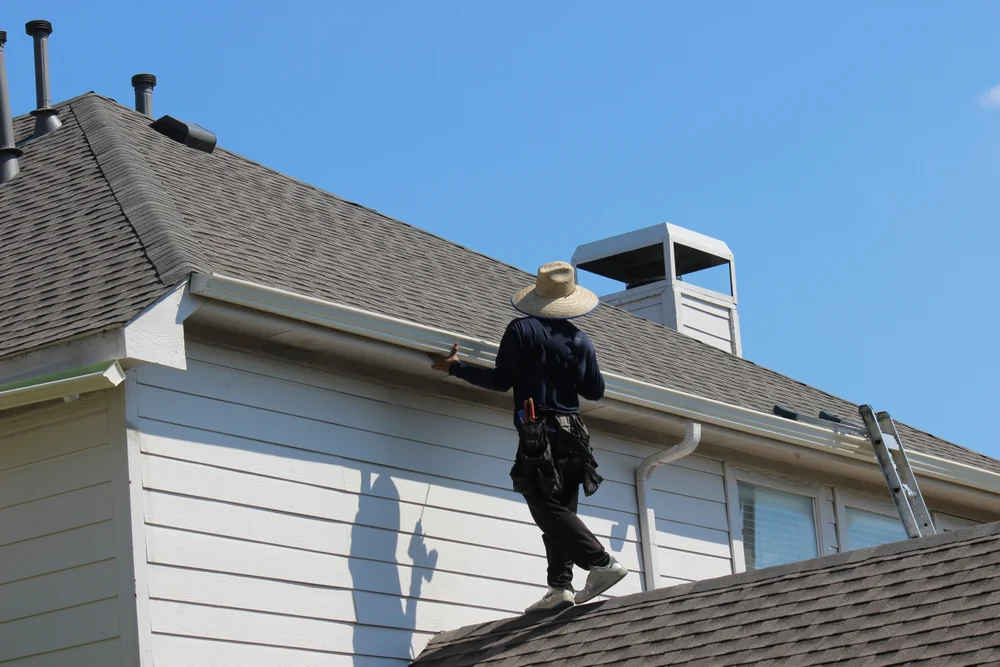
Wind uplift is one of the leading causes of premature shingle failure, and the Merrimack River valley amplifies that risk in a way that’s easy to underestimate if you’re not familiar with the area. The river channel acts as a natural corridor — wind accelerates through it, and homes along the north bank of the Merrimack, through Downtown Haverhill and into Bradford on the south side, bear the brunt of that exposure on a consistent basis.
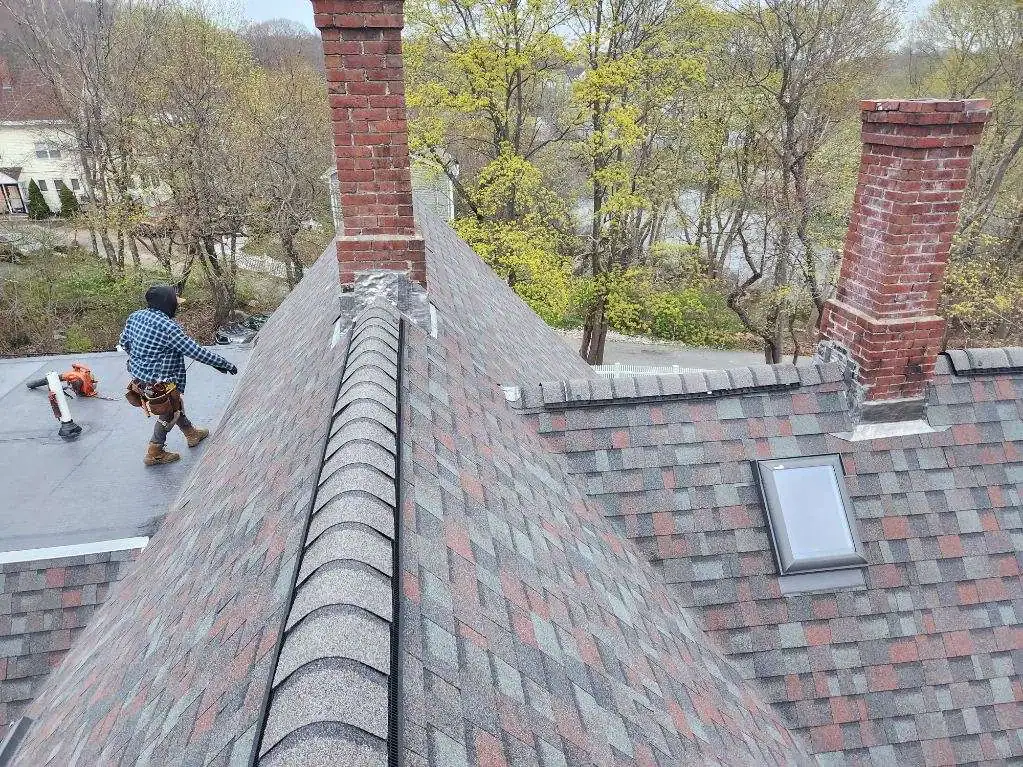
What this means practically is that shingles in certain orientations and exposures in Haverhill lift, crack, and lose granules faster than the same shingles installed in a more sheltered inland location. Flashing around chimneys, skylights, and dormers is also more vulnerable — wind-driven rain finds gaps that wouldn’t be an issue in calmer conditions. If your roof is losing shingles after moderate wind events, or if you’re seeing water intrusion around penetrations that seem otherwise intact, this is worth understanding as a likely cause — not just bad luck.
The fix isn’t complicated, but it does require a contractor who knows to look for it. Proper nailing patterns, appropriate shingle weight and wind rating for the exposure, and meticulous flashing installation around every penetration are the difference between a roof that holds up and one that needs attention again in three years. We use Owens Corning products specifically because of their performance in demanding climates like Essex County’s. Material quality only goes so far if the installation doesn’t account for local conditions.
For homeowners in Riverside, Mount Washington, or along the river corridor in Bradford, this is especially relevant. These neighborhoods see some of the most direct wind exposure in the city, and the older housing stock in those areas means the roofs were often installed without the wind-resistance standards that are now standard practice.
More than a third of Haverhill’s homes were built before 1939. That makes the city’s housing stock one of the oldest in the country — and it creates a specific set of roofing challenges that contractors without experience in this market routinely underestimate.
The most common issue is layered roofing. Older homes in neighborhoods like Riverside, Downtown, and Broad Hill often have multiple generations of shingles stacked on top of each other. Some contractors will quote an overlay — adding a new layer on top of the existing ones — because it’s faster and cheaper. In most of these homes, that’s the wrong call. The underlying decking needs to be inspected, and in many cases it needs to be replaced. Decking from the early 1900s wasn’t built to current load standards, and adding more weight to a compromised deck creates structural risk that shows up later, usually at the worst possible time.
Triple-deckers present their own complexity. The roofline geometry on a typical Haverhill triple-decker — multiple valleys, dormers, and penetrations — requires precise flashing work at every intersection. These are exactly the spots where water finds its way in, and they’re also the spots that take the most time to do correctly. A contractor who’s used to straightforward single-family roofs in newer subdivisions can miss these details or rush through them.
Then there are the converted mill buildings along the Merrimack’s north bank. These properties often have flat commercial roof systems — rubber or single-ply membrane — that require a completely different skill set than asphalt shingle work. We use Mule Hide materials for flat roofing applications because they’re built for commercial-grade durability. Not every residential roofer in Essex County has experience with these systems, and it shows when repairs fail quickly or water pools in areas it shouldn’t.
The point isn’t that older homes are impossible to work with — they’re not. But they do require a contractor who’s actually seen what’s underneath, knows what to look for, and isn’t going to be surprised by what they find once the tear-off starts.
Want live answers?
Connect with a Paradise Remodeling Inc. expert for fast, friendly support.
Wind events and ice dams rarely damage just the roof. When a nor’easter moves through Haverhill, siding takes a hit too — wind-driven rain works its way behind panels, flashing pulls away from walls, and gutters get compromised in the same event that lifts shingles. Treating these as separate problems, to be handled by separate contractors on separate schedules, creates gaps in accountability that homeowners usually don’t notice until the next leak.
As a full-service exterior contractor, we handle roofing, siding, windows, doors, gutters, decks, and skylights — all under one roof. That means one inspection, one assessment, one point of contact, and one warranty conversation instead of three.
Massachusetts has a bifurcated licensing framework for contractors that’s worth understanding before you sign anything. There are two credentials that matter: the Home Improvement Contractor registration, administered by the Office of Consumer Affairs and Business Regulation, and the Construction Supervisor License, required when a job involves structural elements like roof framing or deck replacement. Both are verifiable online. If a contractor can’t provide both — or won’t — that’s a clear signal to move on.
Beyond licensing, the things that actually separate good contractors from bad ones in this market are less formal but just as important. Does the owner answer when you call? Will they put a detailed, itemized estimate in writing? Do they explain what they found during the inspection rather than just telling you what you need to buy?
We’re an Owens Corning Preferred Contractor, which means we meet specific quality and customer service standards — and carry at minimum $1 million in general liability insurance. That credential is verifiable, not just a logo on a website. Feliciano Gomez runs Paradise Remodeling Inc and personally oversees every project. When you call, you’re talking to the person responsible for the work — not a scheduling coordinator or a crew you’ve never met.
For Haverhill homeowners specifically, it’s also worth asking whether the contractor has experience with the type of property you have. A pre-1940 triple-decker in the Bradford neighborhood is a fundamentally different project than a 1990s Colonial in Ward Hill. The flashing requirements, the decking condition, the roofline complexity — all of it differs. A contractor who’s worked across Haverhill’s housing stock knows that. One who hasn’t will find out partway through your job.
The first step is an inspection — and a real one, not a five-minute walk around the perimeter. We get on the roof, check the decking, look at the flashing around every penetration, assess the attic ventilation, and identify anything that’s going to cause problems in the next season. If there’s damage worth documenting for an insurance claim, we’ll tell you. If there isn’t, we’ll tell you that too.
From there, the estimate is written and itemized. No line items that read “materials and labor” as a single number. You should know what you’re getting, what it costs, and why. Haverhill’s labor rates are generally more competitive than Boston metro pricing, and we’re not going to pad an estimate to make up the difference. The goal is a proposal that holds up when you compare it to others.
The actual replacement on a typical Haverhill home involves a full tear-off of existing layers, inspection and replacement of any compromised decking, installation of ice and water barrier at all leading edges (at minimum two feet beyond the interior wall — more in high-risk areas), and then the new roofing system. For homes along the river corridor or in exposed locations, we factor in the wind uplift risk from the start — not as an afterthought once shingles start lifting.
Major shingle manufacturers, including Owens Corning, announced price increases of 6 to 10 percent effective April 2025. Material costs have been climbing steadily. If you’ve been putting off a replacement, the timing is worth factoring into your decision.
Permits are required in Haverhill for roofing work that involves structural decking or new construction. Properties in the historic mill district may require additional design review. We handle the permitting process as part of the project — it’s not something you should have to navigate on your own.
Haverhill isn’t a generic market, and it doesn’t need generic contractor content. The Merrimack River valley wind exposure is real. The aging housing stock is real. The complexity of triple-deckers, mill conversions, and pre-1940 rooflines is real. A contractor who knows these things going in is going to do better work than one who figures it out on your property.
What you’re looking for is someone who’s licensed, insured, accountable, and actually familiar with what Essex County homes deal with across a full New England winter. Those aren’t impossible standards — but they’re worth verifying before you commit.
If you’re ready to have someone take an honest look at your roof, Paradise Remodeling Inc offers free inspections with no obligation. Reach out, describe what you’re seeing, and we’ll take it from there.
Summary:
Article details:
Share: