Traditional gutters fail when New England summer storms hit. Seamless systems handle the downpour without the weak points that cause overflow and foundation damage.
You’ve seen it happen. Clear skies one minute, then a wall of rain rolling across Essex County, MA or Hillsborough County, NH that dumps an inch of water in twenty minutes. Your gutters overflow. Water pours down your siding. And you’re left wondering if this is the storm that finally damages your foundation.
Traditional sectional gutters weren’t built for New England’s summer weather. The seams holding those sections together are exactly where the system fails when a real downpour hits. You’ll learn why seamless gutters handle what traditional systems can’t, what makes them worth the investment, and how they protect your home when the next thunderstorm rolls through.
Traditional sectional gutters come in pre-cut lengths connected by joints and seams. Each connection point is sealed with caulk or fasteners. That works fine in light rain.
But summer thunderstorms in Massachusetts and New Hampshire don’t deliver light rain. They dump water fast. When gutters fill quickly, pressure builds at every seam. Water finds the gaps. Joints that held up for years suddenly leak or separate completely.
The seams also trap debris. Leaves, twigs, and roof granules get stuck where sections connect. Even a small blockage at a joint creates overflow during heavy rain. That overflow doesn’t just make a mess—it saturates the soil around your foundation, seeps into basements, and damages landscaping you’ve spent years building.
Every seam in a sectional gutter system represents a structural weak point. The sealant used to connect sections degrades over time from temperature swings, UV exposure, and moisture. New England weather accelerates that breakdown. Hot, humid summers followed by freezing winters cause expansion and contraction that pulls seams apart.
Water doesn’t need a large gap to cause problems. Even a hairline crack at a seam allows water to escape during heavy rain. That trickle becomes a stream when a summer thunderstorm hits. The water runs down your fascia boards, saturating the wood and creating conditions for rot.
Seams also create turbulence in water flow. Instead of moving smoothly through the gutter, water hits each joint and slows down. Debris accumulates at these points. During a downpour, clogged seams force water to overflow exactly where your home is most vulnerable.
The fasteners holding sectional gutters together face constant stress. When rain gutters fill with water during a storm, the weight pulls on every connection. Over time, screws loosen, brackets bend, and entire sections can separate from your roofline. You might not notice the damage until after the storm, when you’re looking at water stains on your siding or pooling water near your foundation.
Traditional gutters require regular resealing to maintain performance. That means climbing a ladder every few years to apply new caulk at every seam. Miss one section, and you’ve got a leak waiting to happen during the next heavy rain. The maintenance adds up in both time and cost—especially when you’re paying for professional gutter services twice a year.
Temperature changes make the problem worse. Summer heat expands metal gutters. Winter cold contracts them. Each cycle stresses the seams. After a few seasons, even professionally installed sectional gutters start showing signs of failure at the connection points. That’s when homeowners in Middlesex County, MA and Rockingham County, NH start looking into gutter replacement options.
Overflowing gutters don’t just create a waterfall off your roof. They redirect hundreds of gallons of water to places it shouldn’t go. That water lands right next to your foundation, saturating the soil and creating hydrostatic pressure against basement walls.
Foundation damage from improper drainage costs thousands to repair. Water seeping through foundation cracks leads to basement flooding, mold growth, and structural issues that reduce your home’s value. Insurance often won’t cover this type of damage because it stems from maintenance issues. The average water damage claim runs close to $14,000 nationally, and foundation repairs can easily exceed $10,000.
Your landscaping takes a beating too. Overflowing gutters create erosion channels in flower beds and wash away mulch. Plants near the house get waterlogged. Soil compaction from constant water exposure kills root systems and creates drainage problems that persist long after the storm passes.
Fascia boards and soffits absorb water when gutters overflow backward. Wood rot develops quickly in New England’s humid summers. Once rot sets in, you’re looking at replacing entire sections of trim—not a simple repair. It requires removing the gutters, replacing the damaged wood, and reinstalling everything. That’s where gutter repair costs start climbing.
Siding damage shows up as water stains, peeling paint, and warping. Water running down exterior walls finds its way behind the siding, where it sits and causes hidden damage. You might not see the problem until you notice mold or feel soft spots in the wall.
Ice dams become more likely when gutters overflow and freeze. Even in summer, a cool night after a storm can leave standing water in clogged gutters. Come winter, that pattern of poor drainage creates the perfect conditions for ice buildup that damages both gutters and roofing.
The cost of repairing overflow damage adds up fast. Foundation work, fascia replacement, siding repairs, and landscape restoration can easily run into five figures. All of that stems from gutters that couldn’t handle the volume of water a single summer storm delivered. It’s why more homeowners across Essex County, MA are making the switch to seamless systems.
Want live answers?
Connect with a Paradise Remodeling Inc. expert for fast, friendly support.
Seamless gutters are fabricated from a single continuous piece of material, custom-cut to fit your roofline. No seams along the length of the gutter means no weak points where leaks develop. The only connections are at corners and downspouts, drastically reducing potential failure points.
When a thunderstorm hits, water flows smoothly through seamless gutters without hitting joints that create turbulence or trap debris. The continuous design moves large volumes of water efficiently, even during the heaviest downpours New England summers deliver.
Professional gutter installation ensures proper pitch and alignment. Seamless gutters are measured and formed on-site to match your home’s exact dimensions. That precision fit means better performance when it matters most—and it’s why seamless systems can last 25 to 100 years compared to the 10 to 15 years you get from traditional gutters.
The continuous design of seamless gutters eliminates the points where traditional systems fail. Without seams running the length of your roofline, there’s nowhere for water to escape except through the downspouts. That means every drop of rain gets channeled away from your foundation as intended.
Debris flows through seamless gutters instead of getting stuck at joints. Leaves, twigs, and roof granules that would clog a sectional system simply wash through and exit via the downspouts. Less debris buildup means gutters maintain their capacity during storms. Homeowners who add gutter guard installation to their seamless systems report even fewer maintenance headaches.
The smooth interior surface of seamless gutters allows water to move faster. There are no raised seams or joint edges to slow flow or create eddies where debris accumulates. During a summer thunderstorm dropping an inch of rain in minutes, that improved flow rate makes the difference between proper drainage and overflow.
Seamless gutters handle thermal expansion better than sectional systems. The continuous material expands and contracts as a single unit rather than pulling apart at multiple connection points. New England’s temperature swings—from 90-degree summer days to sub-zero winter nights—don’t stress seamless gutters the same way they stress traditional seamed systems.
The reduced maintenance requirement means seamless gutters stay functional longer. You’re not resealing joints every few years or replacing sections that have separated. The system you install continues performing at full capacity season after season. Studies show seamless gutters require about 30% less maintenance time than traditional systems.
Custom fabrication ensures seamless gutters match your roof’s drainage needs. A professional installer calculates the right size and pitch based on your roof area and local rainfall patterns. For New England homes in Hillsborough County, NH and Middlesex County, MA facing summer thunderstorms, that engineering makes a real difference in storm performance.
The weight distribution across seamless gutters is more uniform than in sectional systems. Without joints creating stress points, the entire gutter shares the load when filled with water. That structural integrity prevents sagging and separation even during the heaviest rains—the kind that sweep through Essex County, MA every summer.
Professional gutter installation starts with a thorough assessment of your roofline and drainage needs. We measure every section, note roof pitch and overhang, and calculate the optimal gutter size for your home. For properties in Essex County, MA, Middlesex County, MA, Hillsborough County, NH, or Rockingham County, NH, that assessment accounts for local rainfall patterns and the intensity of summer storms.
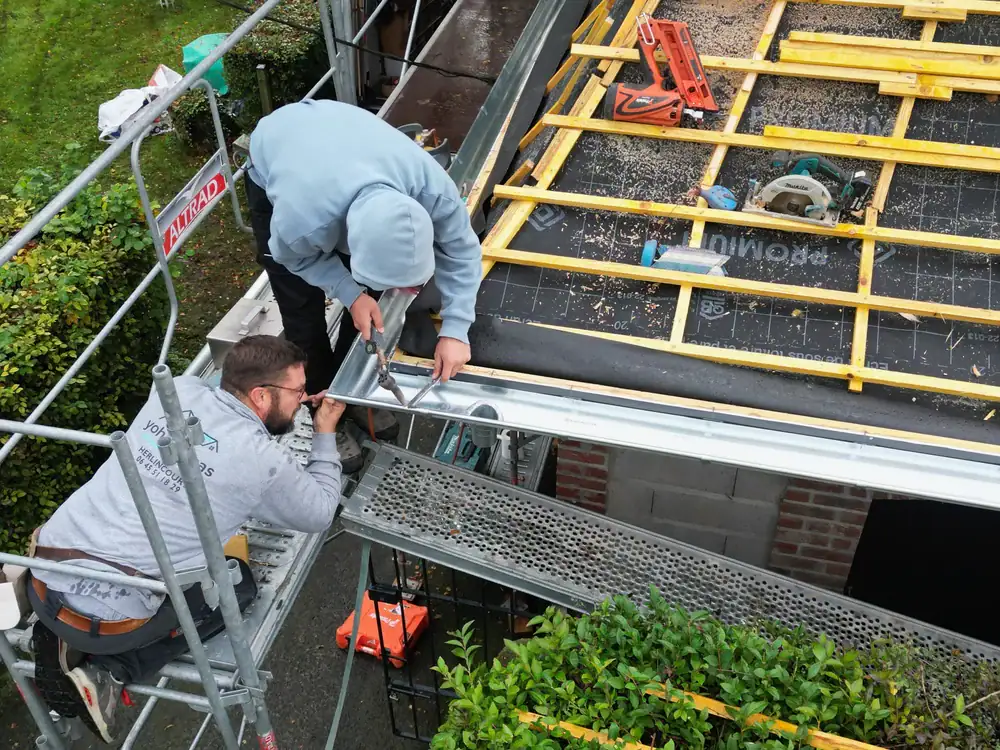
Seamless gutters are fabricated on-site using specialized equipment. A roll of aluminum, copper, or steel is fed through a machine that forms it into a continuous gutter matching your exact measurements. You watch the gutter being created specifically for your home, not pulled from a stock pile of pre-cut sections. This custom approach is what makes seamless gutter installation worth the investment.
We ensure proper pitch toward downspouts. Even a slight error in slope can cause water to pool instead of draining. Professional installation means water flows efficiently even during torrential rain. Most installers in Massachusetts and New Hampshire aim for about a quarter-inch of slope per 10 feet of gutter.
Fascia boards are inspected before installation. If we find rot or damage, it gets addressed before new gutters go up. Mounting seamless gutters to compromised wood creates problems down the road. We won’t skip this step—it’s part of comprehensive gutter services.
Downspouts are positioned to direct water away from your foundation. The number and placement of downspouts depends on your roof area and the volume of water your gutters need to handle. For New England homes, proper downspout placement is critical for managing summer storm runoff. Most homes need one downspout for every 30 to 40 feet of gutter.
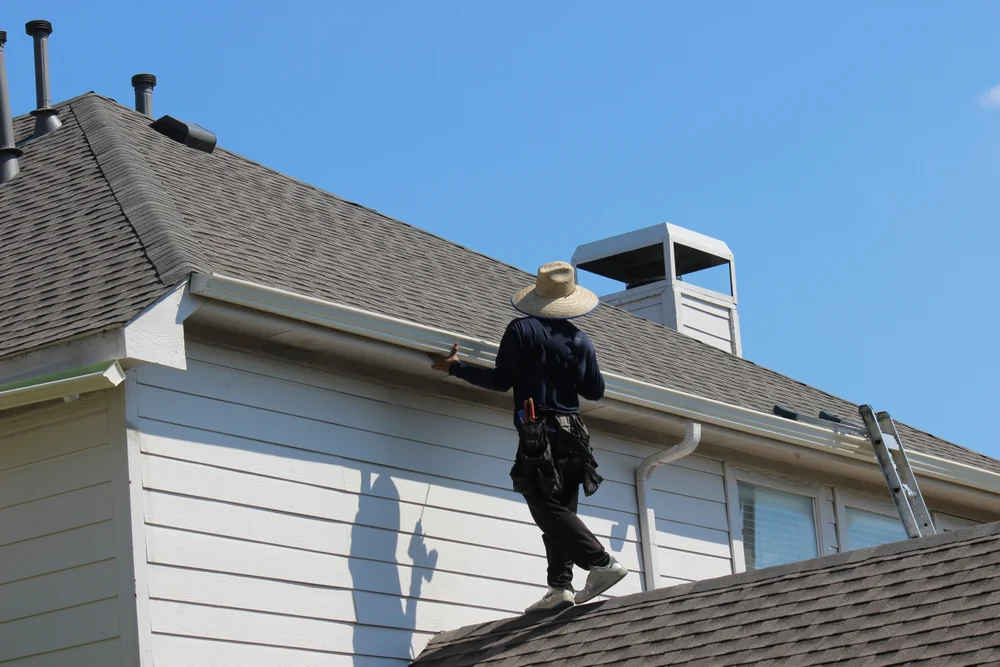
Hidden hangers or brackets secure seamless gutters every 24 inches or less. This close spacing prevents sagging even when gutters fill with water during heavy rain. The hangers attach directly to the fascia board, creating a solid mounting system that withstands years of use.
Corner pieces and end caps are sealed with professional-grade sealant. These are the only points where seams exist on seamless gutters, so proper sealing is essential. A quality installation means these connections remain watertight through countless storms.
The finished installation is tested to confirm proper drainage. We run water through the system to verify flow rate and check for any issues. You see the gutters working before we leave your property. That’s the difference between a professional job and a DIY attempt—you know it’s done right.
Summer thunderstorms in Massachusetts and New Hampshire will keep coming. Traditional sectional gutters with their seams and joints will keep failing when those storms hit. The overflow, the foundation damage, the repairs—all of it is preventable.
Seamless gutters eliminate the weak points that cause traditional systems to fail. They handle the sudden downpours that New England summers deliver. And they do it without the constant maintenance and resealing that sectional gutters require. Most homeowners investing in seamless systems today pay between $2,800 and $5,200 for a complete installation, but they avoid the $8,000 to $14,000 in water damage repairs that failing gutters can cause.
Your home deserves a gutter system that works when it matters most. We install seamless gutters throughout Essex County, MA, Middlesex County, MA, Hillsborough County, NH, and Rockingham County, NH. The next thunderstorm is coming. Make sure your gutters are ready for it.
Summary:
Article details:
Share: