Ice dams form when your attic is warmer than your eaves — and Essex County's winters make that a recurring problem. Here's what's actually happening and what to do about it.
Here’s what most people get wrong about ice dams: they blame the gutters. Every fall, homeowners across Essex County clean out their downspouts, check their drainage, and figure they’ve done their due diligence. Then January hits, a nor’easter rolls through the Merrimack Valley, and the ceiling starts dripping anyway. The gutters had nothing to do with it. The real problem is happening inside your attic — and until that’s addressed, the ice dams will keep coming back. We’ve seen this pattern repeat across Methuen, North Andover, Haverhill, and the North Shore communities year after year. This guide explains what’s actually going on, what you can safely do in the short term, and how to stop the cycle for good.
A roof ice dam is a ridge of ice that builds up along your eaves, typically after a significant snowfall followed by a stretch of below-freezing temperatures. It forms when heat from inside your home escapes into the attic and warms the upper portion of the roof deck. That warmth melts the underside of the snow sitting on the roof.
The meltwater runs down the slope — and when it hits the cold overhang at the eave, where there’s no heat escaping from below, it refreezes. Do that enough times and you’ve got a wall of ice blocking any further drainage. The water that can’t drain has to go somewhere. It backs up under your shingles, seeps through the roof deck, and eventually finds its way into your walls, insulation, or ceiling. By the time you notice a stain or a drip, the damage is usually already done.

Essex County averages 44 inches of snow per year — nearly 60% more than the U.S. average of 28 inches. That alone puts local homeowners in a different category than most of the country. But the geography makes it worse.
The northern half of the county — Methuen, Haverhill, Lawrence, North Andover, and Andover — sits in the Merrimack Valley, where cold Arctic air funnels down from New Hampshire and collides with moisture coming off the Atlantic. Major nor’easters routinely dump 12 to 18 inches across this corridor in a single event. That’s a lot of snow sitting on a lot of roofs.
The North Shore communities face a different but equally difficult version of the same problem. Beverly, Salem, Gloucester, Marblehead, and Rockport get hit with heavy, wet coastal snow — the kind that melts quickly on a warm upper roof deck and refreezes fast once it hits the cold overhang. The melt-refreeze cycle happens faster and more aggressively than it does with lighter inland snow.
Then there’s the housing stock. A significant portion of Essex County’s homes are older Colonials and Garrison Colonials built well before modern insulation standards existed. These houses were designed for a different era of energy efficiency. Their attics often don’t have adequate insulation or ventilation to keep the roof deck uniformly cold in winter — which is precisely the condition that drives ice dam formation.
It’s not a coincidence that the same homes get ice dams year after year. The structure itself is predisposed to it. Essex County has had 27 declared weather disasters since 1972, and freeze-thaw damage is a recurring thread through all of them. This isn’t a freak occurrence — it’s a pattern, and it has a pattern-level solution.
This is the misconception worth addressing directly, because it sends a lot of homeowners down the wrong path. Gutters don’t cause ice dams. Clogged gutters don’t cause ice dams. You can have perfectly clean, freshly installed gutters and still get a significant ice dam every single winter — because the source of the problem is above the gutters, not in them.
What’s actually happening is a heat loss issue. Warm air from your living space leaks into the attic through gaps around recessed lights, plumbing chases, attic hatches, and other penetrations. That air warms the attic, which warms the roof deck, which melts the snow. The meltwater flows down to the cold eave and freezes. The gutters are just bystanders — they’re sitting at the end of a process that starts inside your home.
The permanent fix is to stop that heat from reaching the roof deck in the first place. That means air-sealing the attic floor to close off the pathways warm air uses to escape, and bringing insulation up to a minimum of R-50 where space allows. Proper ventilation — ridge vents and soffit vents working together — also plays a role, because continuous airflow keeps the attic cold and equalizes the temperature across the entire roof deck. When the roof deck is uniformly cold, snow melts uniformly (or not at all), and there’s no temperature differential to create the melt-refreeze cycle at the eave.
This is why ice dam removal alone doesn’t solve the problem. If the attic conditions that created the dam aren’t changed, the next snowstorm starts the process over. Homeowners who’ve paid for removal and then watched the same dam form the following winter aren’t dealing with bad luck — they’re dealing with an incomplete fix.
Want live answers?
Connect with a Paradise Remodeling Inc. expert for fast, friendly support.
Once an ice dam has formed, you have a few options — and the method matters more than most people realize. Some approaches that look fast or cheap can cause more damage to your roof than the ice dam itself. Others are safe but only address the immediate problem without touching the underlying cause.
The most important thing to know upfront: do not chip, hammer, or chisel at an ice dam. It seems intuitive — the ice is solid, you want it gone, a sharp tool seems like the right move. But aggressive mechanical removal cracks shingles, damages flashing, and can weaken the roof surface in ways that won’t be obvious until the next rain or snowmelt. You end up trading an ice problem for a leak problem.

There are a couple of approaches you can take that can reduce the immediate risk without requiring you to get on the roof in January.
The calcium chloride method is the most commonly recommended option. Fill the leg of an old pair of pantyhose with calcium chloride ice melt — not rock salt, which damages shingles, corrodes metal gutters and flashing, and kills nearby vegetation. Lay the filled stocking across the ice dam so it runs perpendicular to the eave and hangs over into the gutter. The calcium chloride slowly melts a channel through the dam, giving trapped water a path to drain. It won’t eliminate the dam entirely, but it relieves the pressure and reduces the risk of water backing up under the shingles.
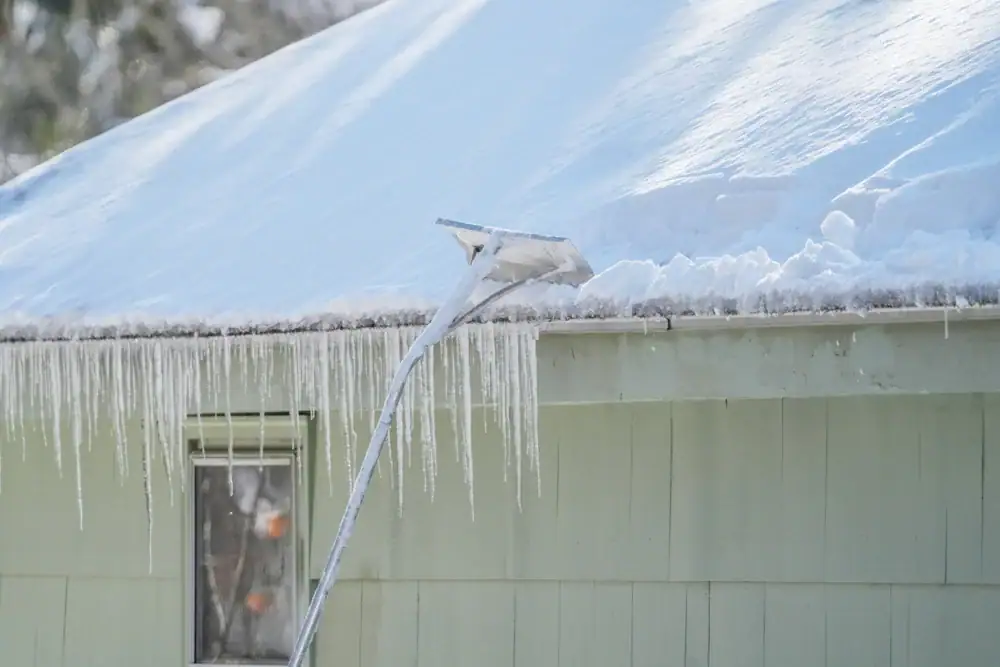
A roof rake is another option, used from the ground on the lower few feet of the roof to clear the snow supply that feeds the dam. The goal isn’t to scrape all the way to the shingles — you want to leave a thin layer of snow on the surface so the rake doesn’t make direct contact with the roofing material. Removing that lower band of snow cuts off the meltwater that would otherwise refreeze at the eave. It’s a preventive measure more than a removal method, and it works best before a dam has fully established itself.
Both of these approaches are temporary. They manage the symptom. Neither one addresses why the dam formed in the first place, and neither will stop a new one from forming after the next storm. If you’ve used these methods multiple winters in a row, that’s a signal that the attic is the real problem.
Icicles hanging from your eaves are a warning sign, not a confirmation. They form under similar conditions that allow ice dams to develop, and they’re worth taking seriously — but icicles alone don’t mean you already have a dam. They mean the conditions are right for one to form, and it’s worth getting a professional set of eyes on the roof before the situation escalates.
If you’re seeing water stains on your ceiling, paint bubbling on interior walls, or visible pooling behind the ice at the eave, the dam has already caused damage and DIY methods aren’t enough. At that point, you need professional removal and a roof inspection to assess what’s been compromised.
Professional ice dam removal is done with low-pressure steam equipment — not pressure washers, not heat guns, not hammers. Steam melts the ice without the mechanical force that cracks shingles or damages flashing. It’s slower than chiseling, but it leaves the roof intact. Any contractor who shows up with a chisel as their primary tool is not someone you want on your roof.
When you’re evaluating who to call, a few things matter. Ask whether the contractor is licensed — in Massachusetts, any contractor doing residential remodeling work is required to hold an active Home Improvement Contractor (HIC) license. Ask whether they carry insurance that specifically covers roof work, not just general liability. And ask what they’ll do after the ice is removed. A contractor who removes the dam and leaves without inspecting the roof for underlying damage isn’t giving you the full picture. Ice dams can compromise underlayment, flashing, and shingles in ways that aren’t visible from the ground — and if those issues aren’t caught and addressed, you’re looking at a leak the next time it rains.
The cost of professional removal ranges from $400 to $4,000 depending on the size of the dam and the complexity of the roof. That range sounds wide, but it’s a fraction of what interior water damage typically costs to repair — the average insurance payout for ice dam-related interior damage runs around $8,000 per incident, and that doesn’t include the removal itself, since insurance covers the damage caused by ice dams but won’t pay to remove them. A full roof replacement triggered by repeated ice dam damage can reach $20,000. Getting professional eyes on the problem early is almost always the less expensive path.
We’ve handled ice dam damage across Essex County — from Methuen and North Andover down to the North Shore communities. Because we handle roofing, gutters, siding, and skylights under one roof, we can assess whether the ice dam has affected adjacent systems, not just the shingles. We’re an Owens Corning Preferred Contractor, we hold an active Massachusetts HIC license, and we use materials from CertainTeed, Mule Hide, and GenFlex that are specifically engineered for New England’s freeze-thaw cycles. If there’s damage, we’ll tell you what it is and what it will take to fix it — no runaround.
The only real solution to ice dams is making the attic cold. That means sealing the air leaks that allow warm indoor air to reach the roof deck, and bringing insulation up to a level — R-50 is the standard — that keeps that heat where it belongs. Ridge vents and soffit vents working together maintain consistent airflow through the attic space, which helps keep the roof deck uniformly cold even during the worst Merrimack Valley winters.
If you’ve had ice dams more than once, or if your home is an older Colonial or Garrison Colonial that predates modern insulation codes, it’s worth having the attic assessed before next winter. The October–November window is the right time — before the first significant snowfall, when there’s still time to address the underlying problem rather than manage the consequences of it.
If you’re dealing with an active ice dam, visible damage, or just want to know where your roof stands before the season starts, we offer free quotes and serve all of Essex County. Reach out and we’ll take a look.
Summary:
Article details:
Share: