Most homeowners check reviews and call it done. Here's what the vetting process actually looks like — and why it matters more than you think.
Most homeowners in Essex County start the same way: a nor’easter rolls through, they spot a stain on the ceiling or a few missing shingles, and they start calling around. Three quotes later, they’re more confused than when they started — different prices, different materials, different everything. The pressure to just pick someone and get it done is real.
But roofing is one of the largest purchases most homeowners make. And the vetting process most people use — check Google, look at reviews, go with the lowest bid — leaves out some of the most important questions. Here’s what actually separates a contractor worth trusting from one you’ll regret hiring.
This is where most homeowners get tripped up. When someone tells you to “hire a licensed roofer,” that advice is correct — but incomplete. In Massachusetts, there are two separate credentials that matter, issued by two separate state agencies, and they’re not interchangeable.
The first is a Home Improvement Contractor (HIC) registration, required for any contractor working on an owner-occupied residential property when the job exceeds $1,000. It’s issued by the Office of Consumer Affairs and Business Regulation and is the minimum legal bar to do residential roofing work. The second is a Construction Supervisor License (CSL), which is required whenever the work involves structural elements — replacing roof decking, reframing, anything beyond surface-level shingle work. A contractor with only an HIC registration cannot legally supervise structural roofing work. A contractor with only a CSL isn’t automatically registered as an HIC. For a full roof replacement, you may need both.
Knowing the credentials exist is one thing. Knowing how to check them is another — and almost no contractor in the Essex County market tells homeowners how to do this, which is exactly why so many people skip the step entirely.
For HIC registration, you can verify a contractor’s status directly through the Massachusetts Office of Consumer Affairs and Business Regulation. The search tool is publicly available online, and all you need is the contractor’s name or registration number. For CSL verification, the Massachusetts Board of Building Regulations and Standards (BBRS) maintains a separate searchable database. Again, publicly available, takes about two minutes.
Why does this matter? Because a contractor can tell you they’re licensed, hand you a business card, and still be operating without current credentials. Licenses lapse. Registrations expire. The only way to know for certain is to look it up yourself. We hold HIC License #195972, which is active and verifiable through the OCABR site — we mention that not to pat ourselves on the back, but because any contractor worth hiring should be comfortable with you checking.
One more thing worth knowing: Massachusetts law under Chapter 142A limits how much a contractor can collect as a deposit before work begins. This is a consumer protection measure specifically designed to prevent the scenario where you hand over a large sum and the contractor disappears. If a roofer is pushing for a large upfront payment before a single shingle comes off your roof, that’s worth questioning.
Here’s the part that catches people off guard: a contractor can be fully licensed by the state of Massachusetts and still install shingles in a way that voids the manufacturer’s warranty. Licensing proves legal permission to work. It doesn’t evaluate how the product gets installed.
Manufacturer certifications — programs like GAF Master Elite, Owens Corning Preferred Contractor, and CertainTeed ShingleMaster — are different. These require contractors to meet specific installation standards, pass training requirements, and demonstrate consistent quality over time. They’re not one-time badges. They’re ongoing credentials that manufacturers review and can revoke. And critically, they’re what unlock the enhanced warranties that actually protect you if something goes wrong years down the line.
GAF Master Elite status, for example, is awarded to roughly the top 2% of roofing contractors nationally. It’s the designation that allows a contractor to offer GAF’s strongest warranty coverage. Without it, even if a contractor uses GAF shingles, the homeowner may be limited to a basic material warranty — and if installation was the problem, that warranty won’t cover it anyway.
We’re an Owens Corning Preferred Contractor, which means we’ve met their standards for quality work and customer service — not just once, but on an ongoing basis. When you’re comparing contractors, asking about manufacturer certifications is one of the fastest ways to separate contractors who know how to install specific products correctly from those who are simply licensed to try.
Want live answers?
Connect with a Paradise Remodeling Inc. expert for fast, friendly support.
Metal roofing has become a serious option for homeowners across Essex County — and for good reason. A properly installed metal roof can last 40 to 70 years, compared to 15 to 30 years for asphalt shingles. It can handle wind speeds up to 140 mph, which matters in coastal communities like Marblehead, Gloucester, and Newburyport where nor’easters hit harder and salt air accelerates wear on standard materials.
That said, not every roofer who installs asphalt shingles is equally qualified to work with metal. The installation process is different, the fastening systems are different, and the flashing details are more exacting. If you’re considering metal roofing, the contractor vetting process matters even more — because a mistake on a metal roof is harder to diagnose and more expensive to correct.
Essex County has a lot of older housing stock. Salem, Lynn, Lawrence, Haverhill — these communities are full of homes built in the late 19th and early 20th centuries, many with complex roof geometries: dormers, multiple pitches, turrets. The character of those homes is part of what makes them worth preserving. Metal roofing can absolutely be the right choice for these structures, but it requires a contractor who understands how to work with older framing and non-standard roof shapes.
For coastal homes specifically, the calculus often favors metal. Salt air corrodes metal flashing and fasteners faster than most homeowners expect, and asphalt shingles in a marine environment don’t last as long as they would inland. A metal roof in a place like Rockport or Swampscott can actually be the more economical long-term choice, even if the upfront cost is higher, simply because you’re not replacing it every 15 to 20 years.
The freeze-thaw cycle is another factor that weighs in metal’s favor across Essex County. Asphalt shingles expand and contract with temperature changes, and over time that cycling degrades the material. Metal handles those fluctuations more durably. If you’re in a home you plan to stay in for decades — or one with a high property value you’re trying to protect — the lifespan math on metal roofing tends to work out.
What you need to verify before hiring a metal roofer is the same list that applies to any roofing contractor, plus a few extras: ask specifically how many metal roofs they’ve installed, what systems they work with (standing seam vs. exposed fastener panels, for example), and whether they have manufacturer training for the specific product they’re recommending. Metal roofing installed incorrectly can leak at the seams, expand against improperly installed trim, and create problems that are genuinely difficult to trace.
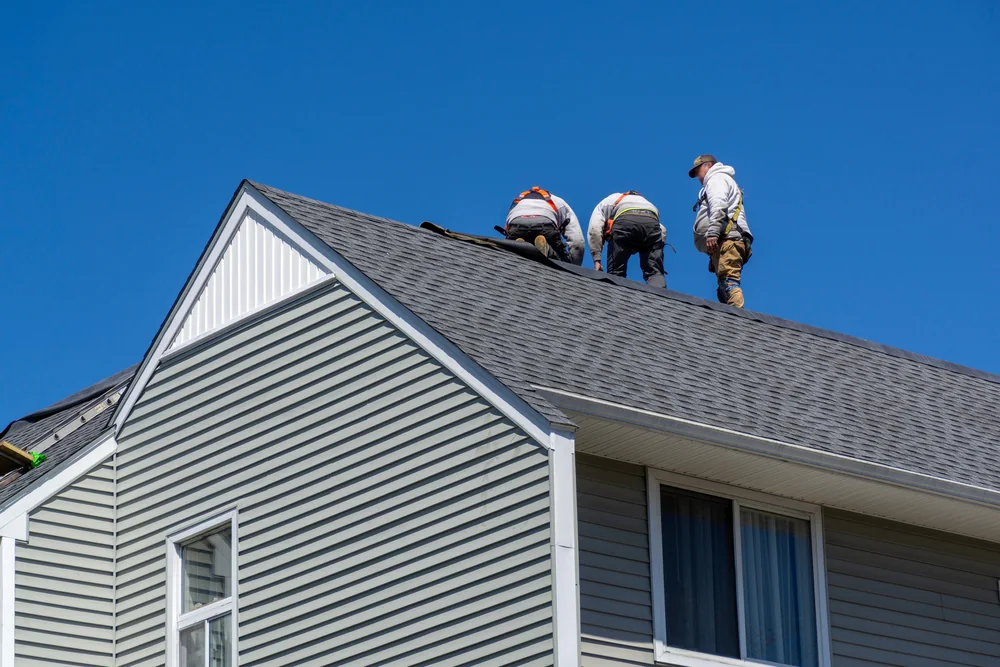
You can research a roofing company thoroughly — verify the license, read every review, check the certifications — and still end up with a crew you’ve never vetted working on your roof. This happens more often than most people realize, and it’s one of the more frustrating experiences a homeowner can have.
Here’s how it typically plays out: a company with solid reviews wins your business. But when demand spikes — after a bad nor’easter, during the fall rush when every homeowner in Essex County is trying to get work done before winter — that company subcontracts the actual installation to a crew that may carry different insurance, may not have received the same training, and may not be held to the same quality standards. The company you hired is still on the contract. But the people on your roof are strangers to both of you.
The fix is simple: ask directly before you sign anything. Ask whether the people installing your roof are employees of the company or subcontractors. Ask whether the owner or a direct supervisor will be on-site during the job. Ask what happens if you have a concern after the job is done — who do you call, and how quickly do they respond?
These aren’t aggressive questions. Any contractor worth hiring will answer them without hesitation. A contractor who gets defensive or vague about crew accountability is telling you something important.
This matters especially in a market like Essex County, where post-storm demand creates real pressure on roofing companies to take on more work than their own crews can handle. The homeowners who get the best results are the ones who ask these questions before the contract is signed — not after they notice something wrong six months later.
We’re involved in every project from estimate through final walkthrough. Our customers consistently mention accountability and accessibility across multiple platforms. We think that kind of responsibility should be the standard, not the exception.
The short version: verify both the HIC registration and the CSL through the actual state agency websites, not just a contractor’s word. Ask about manufacturer certifications and understand what they unlock in terms of warranty coverage. Find out who will physically be on your roof and who is accountable if something isn’t right after the job is done.
Essex County homeowners have a lot of options when it comes to roofing contractors. That’s not a bad thing — but it does mean the vetting process matters more, not less. A roof is a long-term investment on a property that, in this market, is almost certainly worth protecting carefully.
If you’re in the research phase and want a straight conversation about what your roof actually needs — no pressure, no upsell — Paradise Remodeling Inc has been serving Essex County for nearly two decades and is happy to start with a free quote and an honest assessment.
Summary:
Article details:
Share: